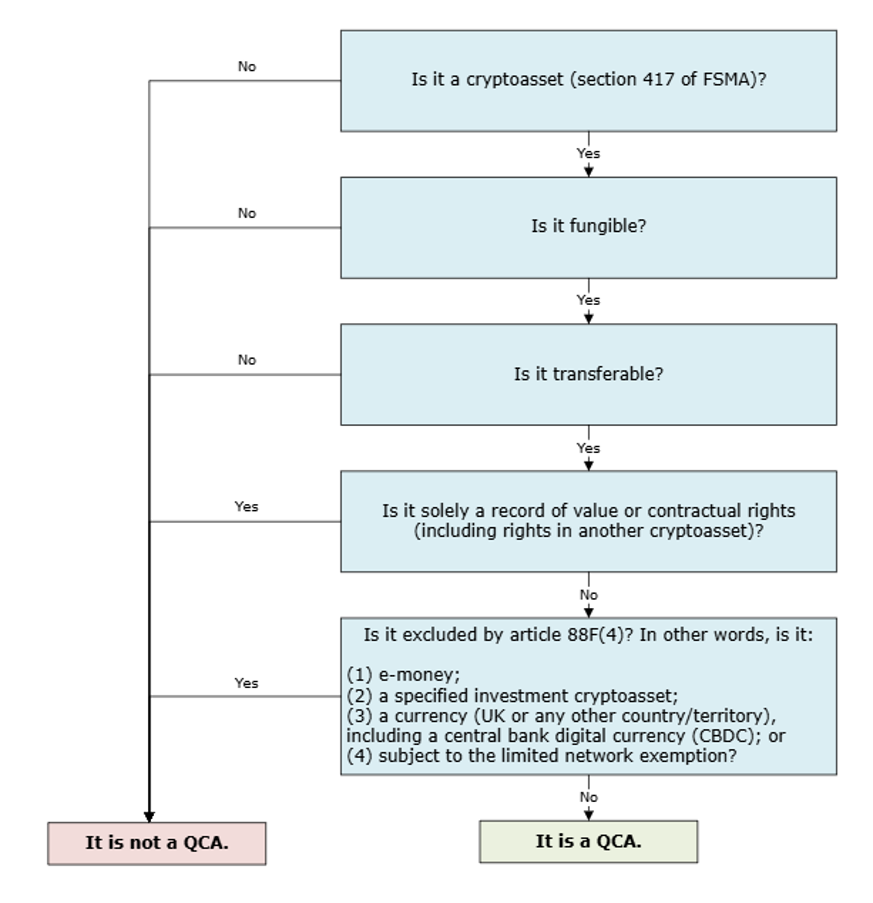
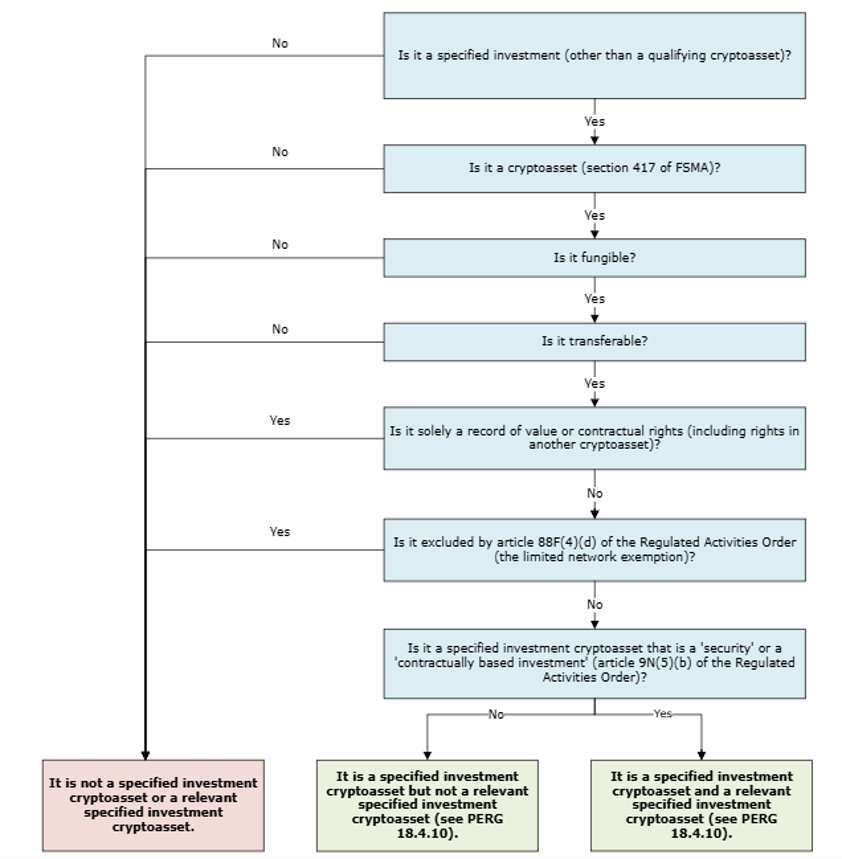
Question 4.4: What sorts of cryptoassets would be ‘solely a record’ for the purposes of article 88F(2)(c) of the Regulated Activities Order?
A cryptoasset will be excluded by article 88F(2)(c) of the Regulated Activities Order where, notwithstanding that it may be cryptographically secured and electronically transferable or storable, it is solely a record of value or contractual rights (including rights in another cryptoasset) and does not function in practice as an asset in its own right.
In assessing whether a cryptoasset is solely a record, it is helpful to take a functional approach to assessing the nature of the cryptoasset. This includes considering the role performed by the cryptoasset in relation to any value or contractual rights associated with it. Relevant considerations that would suggest it is not solely a record may include whether, in practice, the controller of the cryptoasset is able to exercise the associated value or contractual rights, and whether transferring the cryptoasset is the mechanism by which that value is, or those contractual rights are, transferred in practice (as opposed to the cryptoasset being merely evidential of rights that are transferred or constituted by other means). The fact that a cryptoasset is used to identify, evidence or record entitlements to value or contractual rights as part of a legally authoritative record or register does not, by itself, mean that the cryptoasset is more than solely a record.
The definition of a cryptoasset under the Act encompasses cryptoassets that embody value or contractual rights directly, as well as cryptoassets that represent value or contractual rights in another asset. In either case, the relevant question for the purposes of article 88F(2)(c) is whether the cryptoasset is solely a record of value or contractual rights.
A cryptoasset does not become solely a record merely because it represents, evidences or is associated with value or contractual rights relating to another asset rather than embodying value or contractual rights directly. Where the ability to exercise or transfer value or contractual rights relating to the underlying asset attaches, in practice, to the controller of the cryptoasset, rather than by reference to a separate register, record or other mechanism, the cryptoasset is unlikely to be solely a record.
By contrast, a cryptoasset that does not function as an asset in its own right may be solely a record where it simply serves to identify value or contractual rights in another asset, and any transfer of the relevant value or contractual rights in the underlying asset is effected by reference to something other than the transfer of control of the cryptoasset itself.
An example of a cryptoasset that is likely to be solely a record is a cryptographically secured or encrypted spreadsheet, database or ledger (or an entry within one). Such records do not function as an asset in their own right, even where they serve as legally authoritative evidence in respect of entitlements to an underlying asset. Although these cryptoassets are cryptographically secured, electronically transferable or storable, and possibly fungible, they are only a record of value or rights that exist independently elsewhere. The controller of the cryptoasset is unable to exercise that value or those rights, nor effect any transfer of them.
It does not necessarily matter whether the value or contractual rights associated with a cryptoasset arise directly through the cryptoasset itself or by reference to another asset. The relevant issue is whether the cryptoasset functions solely as a record of that value or those contractual rights.
So-called liquid staking tokens and some wrapped tokens, which are issued in exchange for a qualifying cryptoasset that is staked or otherwise held by another with a corresponding ability to exchange that qualifying cryptoasset for the staked qualifying cryptoasset in the future, could be described, at a high level, as cryptoassets that record or represent rights in another cryptoasset. Despite this, the controller of such a token may be entitled to redeem it for the corresponding underlying cryptoasset, and may be able to exercise or transfer that entitlement by virtue of controlling the token. Such tokens may therefore function as a liquid investment in their own right, unlike encrypted spreadsheets and databases. These tokens are therefore unlikely to constitute mere records such that they are excluded from the definition of a qualifying cryptoasset.