This guide sets out an overview of the FCA’s approach to the onshoring of the Markets in Financial Instruments Directive II (MiFID II) in the SYSC sourcebook. The guide focuses on the regulatory regime for UK firms and is aimed at UK MiFID investment firms, that is investment firms that would require authorisation under MiFID and credit institutions carrying on MiFID business, and MiFID Optional exemption firms. The latter comprise advisers or arrangers who do not hold client money or assets and meet other conditions imposed under article 3 MiFID II, so as to be exempt from the Directive’s full application. See PERG 13 Q49.
M2G 2 Onshoring of senior management arrangements and systems and controls obligations
You are viewing M2G 2 Onshoring of senior management arrangements and systems and controls obligations as of . M2G 2 Onshoring of senior management arrangements and systems and controls obligations was last updated on 23/10/2025.
M2G 2.1 Background
01/01/2021G
01/01/2021G
MiFID II contains revised senior management and systems and controls obligations relating to firms. With the exception of one aspect of the whistleblowing obligations in MiFID II contained in primary legislation, onshoring of the MiFID II Level 1 requirements takes the form of regulatory rules. The relevant FCA rules are mainly contained in SYSC but PRA-authorised firms will also be subject to rules in the General Organisational Requirements in the PRA Rulebook.
M2G 2.3 Main types of senior management and organisational requirements in MiFID II
03/01/2018G
MiFID II’s senior management and systems and controls requirements for firms fall into five broad categories:
● management body (article 9);
● general organisational requirements (article 16);
● conflicts of interest (article 23);
● remuneration and performance management of sales staff (article 24);
● whistleblowing (article 73).
Firms operating an MTF or an OTF are subject to additional systems and controls for algorithmic trading (see MAR 5 and 5A). Likewise, MAR 7A contains systems and controls requirements for other firms engaged in algorithmic trading or providing direct electronic access.
23/10/2025G
The general organisational requirements in article 16 are added to by detailed provisions in SYSC including the following areas:
- ● compliance;
- ● risk management;
- ● internal audit;
- ● responsibility of senior management;
- ● complaints handling;
- ● remuneration policies and practices;
- ● personal transactions;
- ● outsourcing;
- ● conflicts of interest;
- ● record-keeping.
M2G 2.4 MiFID II onshoring and SYSC
23/10/2025G
The combination of senior management and systems and controls requirements for firms in a directive and regulation means that FCA rules are used to onshore the provisions in the directive. As such, the approach to onshoring MiFID II retains the familiar approach of the common platform and the following:
- ● the application of common platform requirements in SYSC 1 Annex 1 Part 3 and Table B for MiFID optional exemption firms;
- ● chapter SYSC 10Aon recording telephone conversations and electronic communications;
- ● section SYSC 18.6 on the whistleblowing obligations imposed upon MiFID investment firms which includes a signposting mechanism pointing firms to similar obligations derived from other single market legislation; and
- ● section SYSC 19F in respect of remuneration and performance management of sales staff.
M2G 2.5 Navigating SYSC
03/01/2018G
In order to navigate SYSC material implementing MiFID II, it is essential to follow the relevant application provisions in the sourcebook.
23/10/2025G
SYSC 1.1A summarises the application of the sourcebook to different types of firms. UK MiFID investment firms and MiFID optional exemption firms fall into the category of ‘every other firm’ in SYSC 1.1A and so the applicable chapters are 4 to 12, 18, 19A, 19D and 21. The detailed application of the provisions in chapters 4-10 is cut back in SYSC 1 Annex 1 and it is this annex which provides the starting point for understanding and determining the application of the common platform requirements to your business. More specifically, SYSC 1 Annex 1 Part 3.1G provides a roadmap for individual categories of firms, including UK MiFID investment firms and MiFID optional exemption firms, in explaining how the common platform requirements apply to them. These include requirements that were previously contained in the MiFID Org Regulation and restated to sit within FCA rules.
M2G 2.6 UK MiFID investment firms
23/10/2025G
In the case of UK MiFID investment firms, these are common platform firms for the purposes of the Handbook so are subject to the following MiFID II related obligations:
- ● SYSC 4 to 10 in accordance with SYSC 1 Annex 1 Part 3 Table A Column A. This table identifies whether individual provisions in these chapters apply:
- (i) either as rules or guidance;
- (ii) only to certain sub-categories of common platform firms; or
- (iii) are non-applicable.
These obligations apply to the firm’s regulated activities generally and other activities identified in SYSC 1 Annex 1.2.8R.
- ● Other non-common platform requirements including recording telephone conversations and electronic communications (SYSC 10A), whistleblowing (SYSC 18) and remuneration and performance management of sales staff (SYSC 19F). These chapters apply to a firm’s MiFID and other business to the extent set out in the application provisions of each chapter.
M2G 2.7 MiFID optional exemption firms
23/10/2025G
MiFID optional exemption firms are subject to the following MiFID II related obligations:
- ● SYSC 4 to 10 in accordance with SYSC 1 Annex 1 Part 3 Table B Column A. This table identifies whether individual provisions in these chapters apply:
- (i) either as rules or guidance; or
- (ii) are non-applicable. These obligations apply to the firm’s regulated activities and other activities identified in SYSC 1 Annex 1.2.8R.
- ● Other non-common platform requirements applying MiFID optional exemption firms include recording telephone conversations and electronic communications (SYSC 10A) and remuneration and performance management of sales staff (SYSC 19F). The requirements in these chapters apply to a firm’s business to the extent set out in the application provisions in each chapter.
M2G 2.8 Other firms- Collective portfolio management investment firms and authorised professional firms
01/01/2021
This short summary focuses only on MiFID II onshoring and not obligations arising under other single market legislation
01/01/2021G
A collective portfolio management investment firm (‘CPMI’) takes the form of a ‘UCITS investment firm’ or an ‘AIFM investment firm’, as defined in the FCA Handbook Glossary. A UCITS investment firm is subject to the common platform requirements as set out in Column A+ in SYSC 1 Annex 1 Table A. An AIFM investment firm is subject to the requirements listed in Column A in SYSC 1 Annex 1 Table A in relation to their MiFID business. More generally, both a UCITS investment firm and an AIFM investment firm fall within the Handbook definition of MiFID investment firm broadly when doing MiFID business - this is relevant as regards the application of SYSC 10A (‘Recording telephone conversations and electronic communications’). By contrast, neither SYSC 18 (‘Whistleblowing’) nor SYSC 19.1 (MiFID remuneration incentives) apply to their MiFID business, as a result of the derogations in the application provisions in these chapters.
01/01/2021G
Authorised professional firms falling within the exemption in paragraph 1(d) of Part 1 of Schedule 3 to the RAO will be subject to common platform requirements as set out in Column B in SYSC 1 Annex 1 Table A. If they satisfy the criteria of a MiFID optional exemption firm (in accordance with Chapter 1 of Part 2 of the MiFI regulations) they will be subject to the provisions in the SYSC 1 Annex 1 Part 3 Table B column A. If they fall within both the exemptions in paragraph 1(d) of Part 1 of Schedule 3 to the RAO and Chapter 1 of Part 2 of the MiFI regulations, they are entitled to comply only with the common platform requirements relating to article 2(1)(c) exempt firms in Column B in SYSC 1 Annex 1 Table A. Where they would be required to be authorised by MiFID II, they will be subject to common platform requirements in Column A in SYSC 1 Annex 1 Table A and other SYSC requirements as a UK MiFID investment firm, except to the extent indicated otherwise (including SYSC 1 Annex 1 2.5R).
For an authorised professional firm when carrying on non-mainstream regulated activities, the common platform requirements on financial crime, conflicts of interest and Chinese walls do not apply.
See the definition of authorised professional firms at /handbook/glossary/?starts-with=A. In essence, the definition captures persons regulated by a designated professional body under Part XX FSMA, with a Part 4A permission.
M2G 2.9 Other organisational requirements
01/01/2021G
In addition to the SYSC obligations outlined above, firms will find MiFID II-related organisational requirements in respect of complaints handling in DISP, client money and assets (CASS) and product governance obligations in [PROD]. Firms will also remain subject to obligations in the form of the relevant senior management, certification, COCON and approved persons requirements.
M2G 2 Annex 1 Overview
23/10/2025G
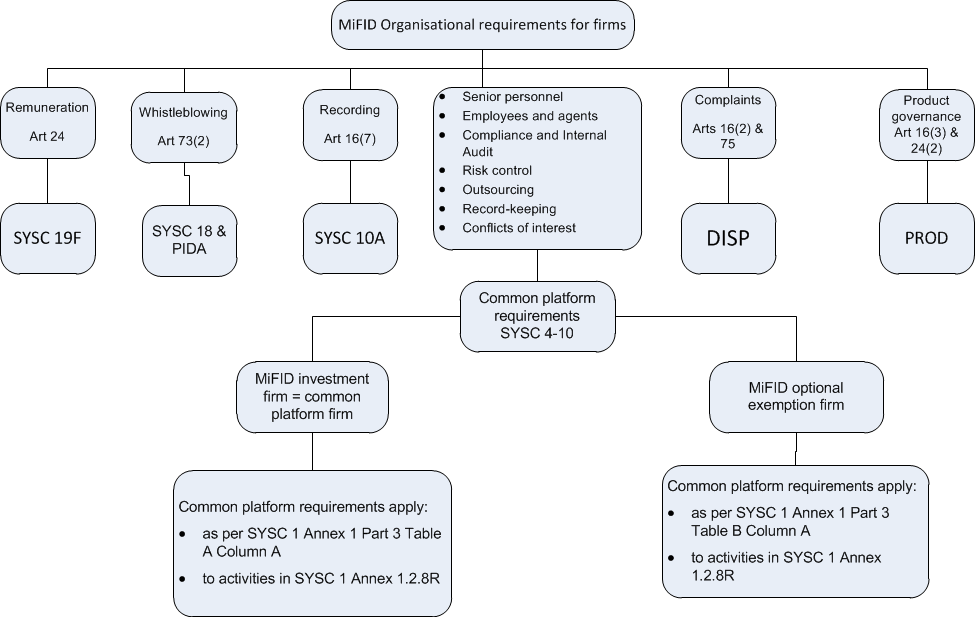
The diagrams in this Annex provide an overview of organisational requirements deriving from MiFID II and the location of their implementation.
The diagram focuses on the position of UK MiFID investment firms (other than CPMI and authorised professional firms) and MiFID optional exemption firms.
MiFID II Organisational requirements for firms